As part of its global 80th anniversary celebration JBL announced this L100 Classic 80a strictly limited special edition of one of the most famous loudspeakers in audio history. This is not a new model, a redesign or an acoustic experiment. It is a Commemorative edition JBL’s modern L100 platform, designed to honor eight decades of engineering, cultural relevance and a speaker that helped define what powerful home audio looked like.
To get straight to the point: The JBL L100 Classic 80 is acoustically and sonically identical to the L100 Classic MKII that is currently in production. Same drivers. Same crossover. Same cabinet volume. Same mood. The only L100 Classic that differs in sound is the reissued original version from 2018, which was replaced by the MKII in 2023. Since then, all versions – the MKII, the Black Edition, the 75th Anniversary and now the Classic 80 – have had the same acoustic package. What changes here is the cosmetic finish and collectability, not the sound.
This is important because JBL is not trying to reinvent an icon. They preserve it.
Originally introduced in the 1970s, the JBL L100 went on to become one of the most commercially successful and visually recognizable speakers the brand has ever produced. It wasn’t subtle, it wasn’t polite, and it didn’t apologize for sounding big, dynamic, and alive. The L100 became synonymous with the rise of serious home stereo systems and remains a reference point for JBL’s identity today.
“The JBL L100 is more than a speaker. It is symbolic of JBL’s role in shaping the way people experience music at home” said Jim Garrett, senior director of product strategy and planning, HARMAN Luxury Audio. “The JBL L100 Classic 80 honors this heritage while reflecting today’s technical standards and listening expectations. It’s a celebration of where we’ve been and how far we’ve come.”
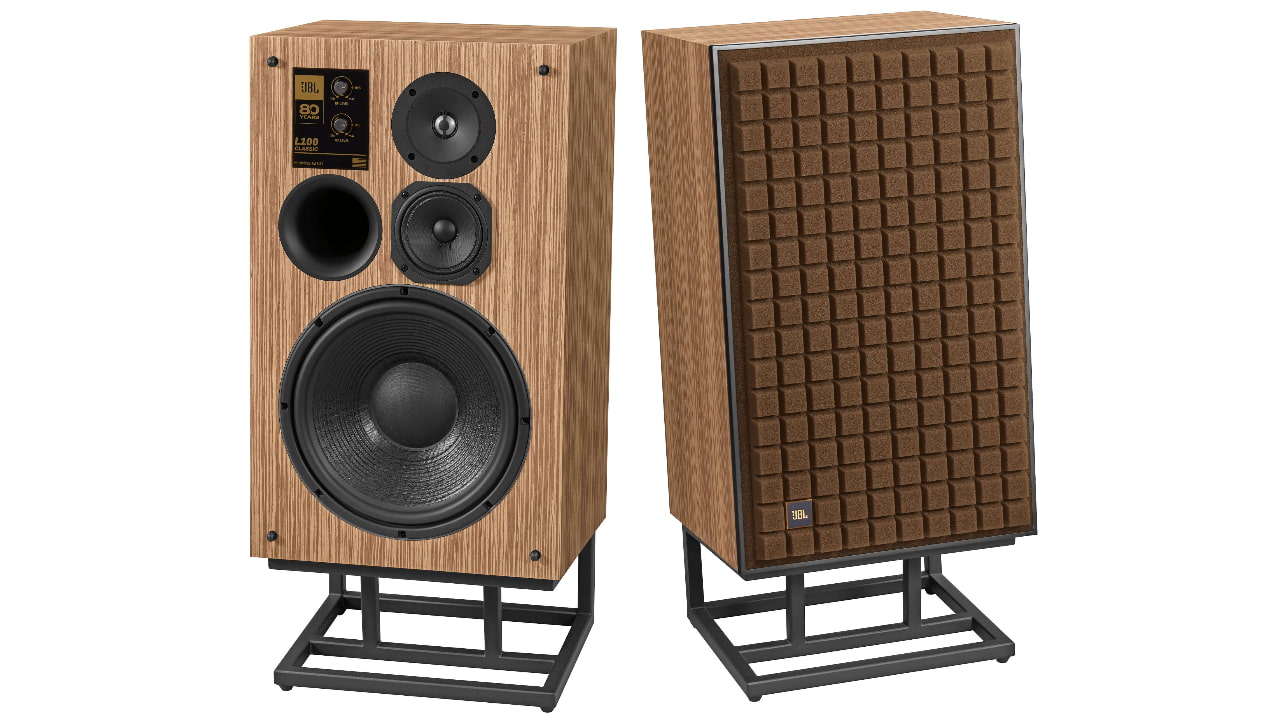
Visually, the JBL L100 Classic 80 Anniversary Edition borrows heavily from its heritage. It is exclusively in finished California oak veneerpaired with a vintage-inspired brown Quadrex foam grille and accented by a gold and black JBL logo. A black satin baffle frame and anniversary emblem on the front and back further distinguish it from the standard MKII. The 12-inch woofer features a black membrane, chosen solely for visual harmony with the overall package – it is the same woofer that is used in the L100 Classic MKII with a white membrane.
Nothing changes under the hood – and that’s the point. The L100 Classic 80 remains a three-way, front-ported bookshelf speaker built around a 12-inch cast-frame pure pulp woofer, a 5.25-inch polymer-coated midrange driver, and a 1-inch titanium dome tweeter paired with JBL’s acoustic lens waveguide. Front-panel mid- and high-frequency level controls allow for fine-tuning, maintaining the vibrant, customizable character that made the L100 famous.
What really sets the L100 Classic 80 Anniversary Edition apart from all other modern L100 variants is its availability – and its finality.
Production is limited to 800 matching pairs worldwide. That’s it. Each pair includes JS-150 speaker stands, ships in a custom-made wooden crate, and features an individually numbered commemorative plaque signed by senior systems engineer Chris Hagen. This is a one-off release with no follow-up runs planned.
For comparison: All previous L100 special editions have already disappeared:
- The 75th anniversary edition (2021 model) was limited to 750 pairs and sold out in 2021
- The Black edition (2022 model) stopped production at the end of 2024
- The L100 classic (2018 model) was discontinued when the MKII was released in 2023
That leaves only two L100 options for the future: the standard L100 Classic MKII, available in walnut with multiple grille colors, and the L100 Classic 80, which exists exclusively to celebrate JBL’s 80th anniversary – and then disappears.
The modern reference behind the L100 Classic 80 Anniversary Edition
At first glance, the L100 Classic 80 looks like a time travel straight from the 1970s – and that’s intentional. Its physical dimensions (25 x 16 x 15 inches) have changed little in more than five decades of L100 history. The weight is also in the same range: just under 60 pounds per speaker, compared to around 55 pounds for the original. This has always been a solid speaker, but one that doesn’t fit into modern categories. It’s too large to be a real bookshelf and too compact to be a traditional stand.
In the past, L100s were often parked directly on the ground, next to a stereo system and just a few meters apart. These days they are more commonly placed on low stands – about 7 inches off the ground, tilted slightly back, with 8 to 10 feet of space between them. Same speaker, different era, better placement.
The L100 Classic 80 continues to be a three-way design with a 12-inch woofer, a 5.25-inch midrange driver, and a 1-inch tweeter. The midrange driver is located next to a 5-inch front-firing bass port and the cabinet retains the classic look: black front and back panels with walnut veneer on the sides, top and bottom. Visually it checks every L100 box.
Internally it is a completely different animal.
The case is significantly stiffer than previous versions and features inch-thick front and back panels, ¾-inch side panels and extensive internal bracing. JBL has also developed a custom internal damping material with higher absorption than standard Dacron fill, helping to control internal reflections and case resonance.
The crossover network has also been thoroughly updated. Thicker leads, larger capacitors and a mix of iron core and air core inductors are used, with crossover points set at 450 Hz and 3.5 kHz. The midrange driver uses second-order filters across the entire range, while the tweeter uses a third-order high-pass filter. This approach keeps the fundamentals and vocal presence squarely in the midrange driver’s wheelhouse, rather than awkwardly splitting them between drivers, helping to avoid phase issues and maintain clarity.
On the front, the L100 Classic 80 retains one of its most distinctive features: adjustable midrange and treble attenuators. These controls don’t increase anything – they just reduce performance. While the middle position is marked as “Neutral”, there is a useful range for turning back. In practice, it is possible to reduce the range from 600 Hz to 2 kHz by almost 10 dB using the midrange control and also reduce the energy above about 5.5 kHz using the treble attenuator. It’s a practical room adjustment tool, not a tone control gimmick.
In terms of driver technology, the tweeter is from JBL JT025Ti-4a 1-inch titanium dome mounted in a flat waveguide with an acoustic lens. The same tweeter appears in the L52 and L82 models, but what sets it apart is the use of a large ferrite magnet instead of the neodymium magnets commonly used today. Ferrite acts as a better heat sink, allowing the tweeter to operate at lower temperatures and reducing thermal compression distortion at higher output levels.
However, the midrange and woofer are unique to the L100 Classic MKII and Classic 80.
The midrange is the 105H-1a 5.25″ pure pulp polymer coated cone driver designed as a sealed unit. Unlike the open midrange of the smaller L52, this sealed design prevents cabinet air pressure from interfering with driver movement, helping to maintain consistency and control over the critical tuning range.
The bass duties are taken over by the JW300PW-8a 12″ pure pulp woofer with a cast aluminum frame and a solid 3″ voice coil. Its magnet assembly is 7 inches in diameter and over an inch thick, allowing for significant deflection. This magnetic structure alone accounts for almost a third of the speaker’s total weight, with the woofer alone tipping the scales at almost 22 pounds.
On paper, the L100 Classic MKI is rated 40Hz to 40kHz (-6dB)with a sensitivity of 90dB (2.83V/1m) and a nominal 4 ohm impedance. These numbers tell you what you need to know: This is a speaker that plays loud without being intrusive, rewards solid amplification, and delivers scaling that smaller, modern designs simply can’t fake.
Specifications
| Speaker type | 12-inch (300mm) 3-way bookshelf speaker |
| Low frequency driver | 12-inch (300 mm) cast frame woofer with Pure Pulp cone and dual spider (JW300SW-8) |
| Mid-frequency driver | 5.25″ (130mm) Polymer Coated Pure Pulp Cone (JM125PC-8) |
| High frequency driver | 1-inch (25mm) titanium dome tweeter paired with acoustic lens and waveguide (JT025Ti2-4) |
| Recommended amplifier power | 25-200 watts RMS |
| impedance | 4 ohms |
| Sensitivity (2.83V/1m) | 90dB |
| Frequency response | 40Hz-40kHz (-6dB) |
| Crossover frequencies | 450Hz, 3.5kHz |
| Dimensions with grid (HxWxD) | 25.3 inches x 15.4 inches x 14.4 inches |
| Controls | Attenuators for MF and HF level control |
| Plug type | Two sets of gold-plated binding posts |
| Product weight | 63 lbs (28.6 kg) each. |
The conclusion
The JBL L100 Classic MKII And Classic 80th anniversary edition are not subtle, not trendy and do not pretend to be something they are not. It’s a big, physical speaker with modern technology and a very consciously old-school attitude. The same proven acoustic platform used on all newer L100 variants, solidly built, properly tuned and outrageously dynamic.
This is for listeners who actually turn the volume knob, have the space to let a speaker breathe, and don’t want their gear to disappear into the décor. If you want scalability, punch and the ability to tailor the sound to your room, the L100 is for you. If you’re looking for minimalist boxes, ruler-shaped charts, or lifestyle credibility, keep scrolling.
Where to buy
Note: All other L100 Classic models have been discontinued. A set of Quadrex foam grilles is included, but can also be purchased separately in a variety of colors for $394.95/pair at Crutchfield. The accompanying JS-150 or JS-120 speaker stands are not included but are available from Crutchfield for $364.95/pair.