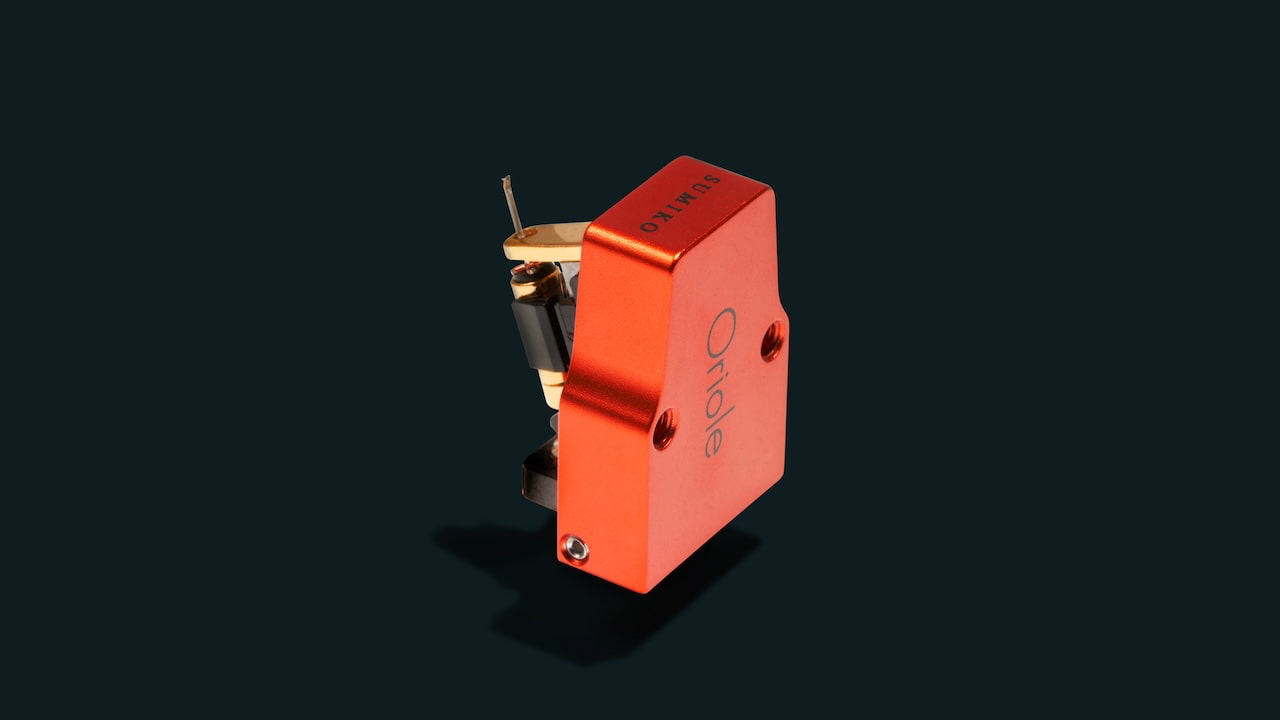
Sumiko doesn’t need a comeback story, a reinvention arc or a memory tour. They have been building handcrafted Japanese phono cartridges for decades, and anyone familiar with models like Wellfleet, Amethyst or Blue Point No. 3 already knows the score. Sumiko’s track record is well established. What defines the oriole is the place where it lands. At $1,699, it falls squarely into the range long dominated by some of the most powerful, low-output moving-coil cartridges from Hana, Ortofon, and high-end offerings from Audio-Technica and Dynavector – all without straying into boutique pricing above $2,000.
It’s been a while since Sumiko aimed directly at this group, and the Oriole shot is a deliberate shot. Handcrafted in Japan and positioned between Songbird and Starling, the Oriole uses a naked Shibata stylus mounted directly to the cantilever, reducing tip mass compared to bonded designs and improving high-frequency sampling accuracy. The extended contact area of the Shibata tread increases contact with the groove wall, which reduces local pressure, improves tracking at lower forces and reduces tracking distortion, especially on inner grooves and complex passages. If the alignment is sloppy, you will be notified.
The Oriole is a low output moving coil cartridge with a 0.3mV output. In plain English, that’s what it means requires a phono preamplifier that specifically supports moving coilas the power delivered by the pickup is much lower than a moving magnet pickup. So you look for an MC phono stage (or an MM stage plus a step-up device) and use one higher profit Setting than with an MM pickup.
At the pin end, the Oriole uses a 6.5 × 40 micron bare Shibata profile, selected for its extended contact area along the groove wall. Compared to simpler elliptical shapes, this allows for more accurate tracking of high frequency information and improved performance on internal grooves, provided alignment is careful. The pen is mounted on a reinforced 0.5mm diameter aluminum cantilever, a material choice that balances stiffness, durability and controlled mass rather than seeking exotic alternatives.
With a mass of 7.3 grams and a conformity rating of 12 × 10⁻⁶ cm/dyne at 100 Hz, the Oriole is well suited to medium mass tonearms commonly found on modern turntables. The recommended tracking force of 2.0 grams is within a known and stable range for moving coil designs and supports consistent tracking across a variety of records.
A channel separation of 30 dB and a tight channel balance contribute to stable imaging, while the specified frequency response of 12 Hz to 45 kHz indicates a bandwidth that extends well beyond the audible range without overstating its importance.
The other key number is the internal impedance of 5.5 ohms. This is important because most MC phono preamps allow you to select a “load” setting and the cartridge is designed to be used with the type of adjustable load and gain that you get from MC phono preamps actually purchased in this price range. Think McIntosh, MOON by Simaudio, EAT and Pro-Ject phono preamps, as well as other common high-end MC designs, not five-figure phono preamps.
Practically speaking, the Oriole makes sense on turntables like McIntosh’s MT series, VPI decks under $5,000, classic and modern Thorens models, Michell Audio designs, and Pro-Ject tables once you move beyond the Debut series.
The striking orange casing may be the first thing you notice, but the real story is simpler. Sumiko didn’t rush into launching a new model or chasing trends. The Oriole exists because there was room at this price for a cartridge that competes with the best in its category – and Sumiko decided it was time to take that space back.
Where the Oriole fits into the Sumiko range
star
The price is $1,999 star is at the top of Sumiko’s moving coil range and is intended for high quality turntables and phono stages that can take advantage of its resolution. It weighs 9.5 grams and uses a conventional cartridge body size, making it compatible with most modern medium mass tonearms without special counterweights or setup workarounds.
At the front end is a solid, ultra-low mass microridge needle mounted on a boron cantilever. In practice, this stylus profile is designed to follow the record groove very precisely, particularly on tightly cut records and inner grooves where simpler stylus shapes cause problems. The boron cantilever is both stiff and lightweight, allowing the pen to respond quickly to changes in the groove while maintaining control.
The Starling produces 0.5mV, which is slightly higher for a low output moving coil cartridge. This makes it easier to adapt to a wide range of MC phono preamps as extreme gain settings are not required. Its internal impedance of 28 ohms means it works best when loaded with 100 ohms or more, a setting common to many MC phono stages.
songbird
The $899 songbird is Sumiko’s high-performance moving coil cartridge designed for listeners who want the speed and clarity of a moving coil design without the added cost or complexity of a dedicated MC phono preamp. With an output of 2.5mV and a standard load requirement of 47kOhm, it can be used with most moving magnet phono stages, making it an easy upgrade path from MM cartridges.
Weighing 8.5 grams and a standard cartridge body size, the Songbird works well with most modern medium mass tonearms. Its elliptical needle is less complex than the profiles used on higher-end models, but it is forgiving of setup errors and recording conditions, making it well suited for everyday listening across a variety of pressings.
The aluminum boom is slightly heavier than boron or other exotic materials, but offers predictable behavior and durability. The tracking force is set to the familiar 2.0 grams and the compliance is tailored to common tonearms, including Pro-Ject, VPI and Thorens turntables.
With a frequency response up to 40 kHz and solid channel separation, the Songbird delivers a clear, balanced presentation with good stereo image while remaining suitable for systems not based on high gain MC electronics.
The conclusion
At $1,699, the Oriole lands right in the middle of Sumiko’s serious moving-coil lineup, between the Songbird and the Starling, putting it squarely in a crowded and very competent field. This is the same price range in which cartridges from Hana, Ortofon, Audio-Technica and Dynavector already have a long track record and clear technical identities. The Oriole makes sense for listeners with well-stocked turntables and a real MC phono stage who are looking for performance and system suitability rather than curiosity.
The Sumiko Oriole is a low output moving coil cartridge with a bare Shibata stylus and a 0.3mV output to a 5.5 ohm generator. That tells you exactly what it is and what it isn’t. It is not suitable for moving magnet inputs and is unforgiving of a weak or poorly implemented phono stage. If your phono preamp doesn’t have the correct MC gain and loading options, the Oriole is simply the wrong cartridge.