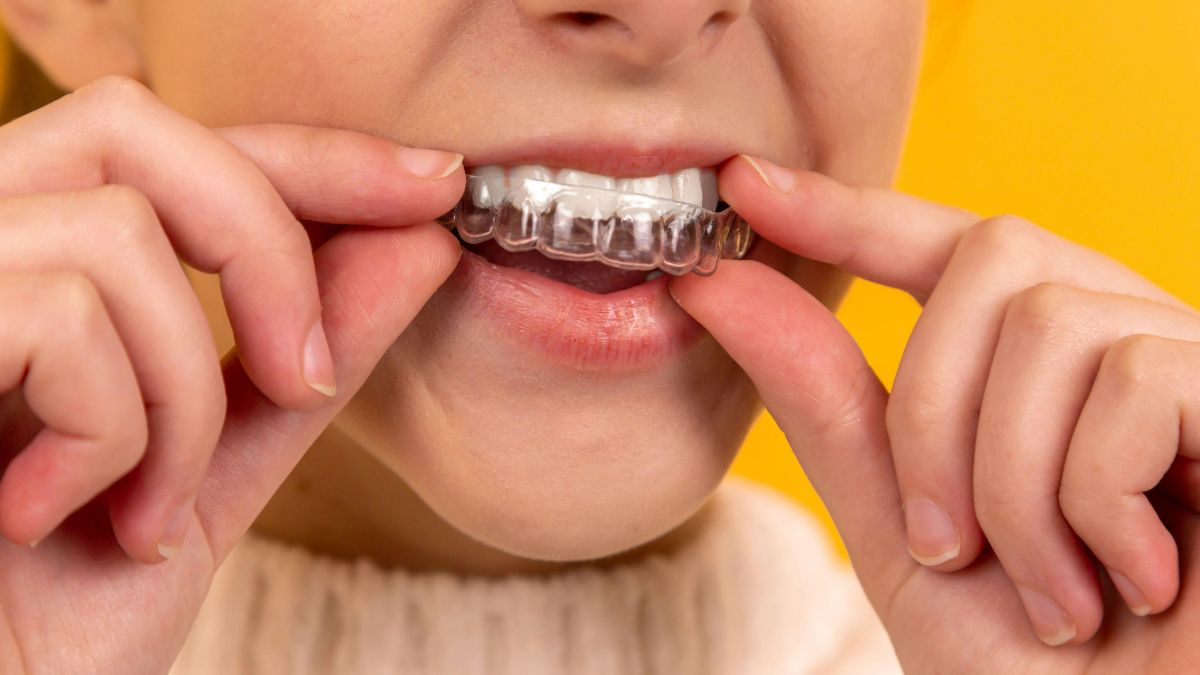
Many parents considering braces for their children are concerned about how reliable and effective the treatment is during the growing years. Parents compare aligners to braces for children. Because of the benefits of early intervention, families seek treatment for young children that addresses problems early.
Families want a solution that doesn’t require the involvement of children who aren’t ready for removable devices. The American Association of Orthodontists (AAO) recommends an evaluation at age seven. This allows experts to identify problems early and treat patients without complications.
Smiles+Grins, a leading specialty clinic in Manhattan, helps parents and patients of all ages make the right choice that meets their specific needs.
Braces vs. Clear Aligners: Key Differences That Matter to Children
Traditional braces use rigid brackets and wires that attach to the teeth. They deliver a force that requires no intervention from the patient and keeps the force on the teeth
all the time.
Clear aligners like Invisalign First are splints. They are worn for 20 to 22 hours daily to allow the teeth to move slowly.
In children (ages 6 to 10 with mixed dentition), braces move the teeth in a predictable way, regardless of what the child does each day. Aligners must be worn constantly. This can be difficult for children if they forget or lose the trays.
Why younger children are often not ready for aligners
Young children lack the responsibility and commitment required by aligners. Aligners require a lot of discipline as they have to be worn constantly and removed at meals. The aligners must be cleaned properly. Forgetting to insert the aligners or losing the aligners can significantly delay progress.
With braces, however, this problem does not exist because the braces are fixed. Braces keep treatment uninterrupted when a young child forgets something or is very active.
The biggest hurdle with aligners in young children
Compliance is the biggest problem in orthodontic treatment for young children. With aligners, the child must strictly adhere to the schedule, and this can be challenging as young children can be forgetful and very active. The result is lost splints, short wearing times and longer treatment times.
Lack of compliance frustrates families. The lack of compliance also reduces the effectiveness of the treatment, especially when the dentist needs control during the growth phases.
Superior effectiveness of braces for common early orthodontic problems
Braces correct problems such as crowding, crossbites, overbites, underbites or jaw problems. Braces use the fixed appliances to apply the force and also attach the rubber bands or expanders that the aligners cannot handle well in growing mouths. In Phase 1 of treatment for children ages seven to ten, braces control jaw growth and create space in a predictable manner.
While thinking Aligners vs. braces for childrenHere are some cases where braces are superior to aligners:
- Severe crowding or rotated teeth require strong, continuous torque.
- Bite problems such as anterior crossbites must be addressed immediately to prevent speech or swallowing problems.
- Jaw growth guidance with expanders or integrated headband with fixed braces.
Long-term benefits of starting braces early
Use Braces for children early (phase 1) shortens the entire treatment. They reduce the likelihood that the dentist will have to extract teeth or perform surgery later. Braces prevent problems caused by uneven wear of young teeth.
Braces correct bone problems during growth spurts. It forms a base for the teeth and often facilitates phase 2 treatment in adolescence.
Parental decision factors that go beyond clinical recommendations
Here are the factors parents should consider before making a decision for their children outside of clinical recommendations.
- Maturity level of the child
- Lifestyle/sports and daily habits of the child
- The appearance of the teeth
- Cost of treatment.
- Emotional factors
Braces start at a lower price and help avoid the replacement costs associated with aligners. Parents also take the child’s emotions into account. Whether the child can handle responsibility or whether the child prefers a set-it-and-forget-it approach.
Expert insights and current orthodontic guidelines
AAO recommends that children be screened early at age seven. The AAO also recommends that fixed appliances be used for care in Phase 1 when growth can be used for correction.
Invisalign First may be recommended in some cases for children as young as 6 years old who are compliant. However, for complex cases, braces remain the preferred choice for children.
In conclusion
Many families choose to get braces for their children instead of waiting for aligners because braces are more predictable. Braces do not require compliance and are good for children’s treatment problems. Fixed braces control growth and help children achieve a long-term smile.
Than that Aligners vs. braces for children continues, a doctor’s individual assessment can help choose the best option for the child.
Were you able to choose between braces and aligners? What factors did you consider? We would like to know.
Image by Diana Polekhina and Atikah Akhtar from Unsplash
The Market Pulse Brief editorial team was not involved in the creation of this article. The views and opinions expressed in this post are those of the advertiser and do not reflect those of Market Pulse Brief. Market Pulse Brief assumes no liability for any loss or damage arising from the use of any products or services, nor do we recommend any products, services or links in our sponsored articles