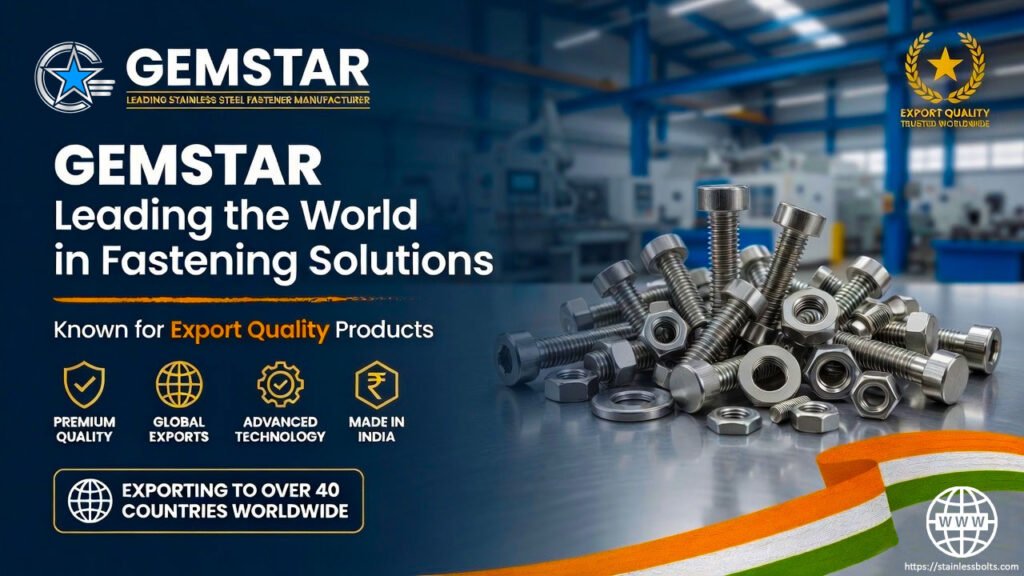
A small fastening component can have a major impact on the safety, durability, and performance of an entire structure or product. From industrial machinery and construction equipment to automotive assemblies and infrastructure projects, stainless steel fasteners India provide dependable mechanical connections while offering strong resistance to corrosion and environmental exposure. Their combination of durability, versatility, and clean appearance makes them suitable for demanding applications across many industries.
For businesses sourcing industrial fasteners, product quality is only one consideration. Material grade, dimensions, thread accuracy, mechanical properties, surface condition, application environment, and supplier consistency all influence the final performance of a fastening system. This is why selecting experienced stainless steel fasteners manufacturers can be an important part of procurement planning.
What Are Stainless Steel Fasteners?
Stainless steel fasteners are mechanical components manufactured from stainless steel alloys and used to join, secure, or assemble two or more components. Common examples include bolts, nuts, screws, washers, studs, and threaded rods.
Stainless steel contains chromium, which contributes to the formation of a passive oxide layer on the surface. This protective layer helps the material resist corrosion under many normal environmental conditions.
However, not every stainless steel fastener is suitable for every application. Different stainless steel grades offer different combinations of corrosion resistance, strength, temperature performance, and chemical resistance.
Common Types of Stainless Steel Fasteners
Depending on the application, buyers may require different fastening products, including:
- Stainless steel bolts
- Stainless steel nuts
- Stainless steel screws
- Stainless steel washers
- Stainless steel studs
- Threaded rods
- Hex bolts and nuts
- Socket head screws
- Machine screws
- Self-tapping screws
- Specialized industrial fasteners
The correct selection depends on the assembly design, loading conditions, operating environment, and applicable specifications.
Why Stainless Steel Fasteners Are Widely Used
One of the biggest advantages of stainless steel is its resistance to corrosion. This makes stainless steel fastening components particularly useful in environments where moisture, humidity, chemicals, or outdoor exposure may affect ordinary carbon-steel components.
They are commonly considered for applications such as:
- Construction and infrastructure
- Food-processing equipment
- Chemical and pharmaceutical facilities
- Automotive manufacturing
- Marine and coastal environments
- Industrial machinery
- Solar and renewable-energy installations
- Architectural structures
- Electrical and engineering equipment
In addition to corrosion resistance, stainless steel can provide a clean, professional appearance. This is useful when fasteners remain visible in architectural or equipment applications.
Stainless Steel Fasteners: How to Choose the Right Grade
Choosing the correct stainless steel grade is more important than simply selecting a product labelled “stainless steel.” Different grades have different characteristics.
Stainless Steel 304
Grade 304 is one of the most widely used stainless steel grades. It offers good general corrosion resistance and is suitable for many indoor and outdoor applications.
It is frequently used for general engineering, architectural components, food-related equipment, and industrial assemblies where moderate corrosion resistance is required.
Stainless Steel 316
Grade 316 contains molybdenum, which improves resistance to certain corrosive environments. It is often considered for marine applications, chemical environments, coastal locations, and other situations where greater corrosion resistance is required.
The appropriate grade should always be selected according to the actual service environment rather than assumed solely from the product name.
What Should Buyers Check Before Ordering?
Selecting the right fastener involves more than checking diameter and length. A reliable procurement process should consider the complete application.
1. Material Grade
Confirm whether the required material is 304, 316, or another specified stainless steel grade.
2. Dimensions and Thread
Check diameter, length, thread pitch, thread type, head style, and dimensional tolerances. Incorrect dimensions can lead to poor fitment or assembly problems.
3. Mechanical Requirements
Consider tensile strength, load requirements, hardness, and other mechanical properties relevant to the application.
4. Operating Environment
Evaluate exposure to moisture, salt, chemicals, heat, outdoor conditions, or other factors that could influence corrosion and service life.
5. Standards and Documentation
For critical applications, buyers should ask suppliers about applicable product standards, material certificates, inspection procedures, and quality documentation.
How Stainless Steel Fasteners Manufacturers Support Industrial Buyers
Experienced stainless steel fasteners manufacturers do more than supply standard components. They can help buyers understand material selection, dimensions, specifications, customization requirements, and application suitability.
This technical understanding becomes particularly valuable for businesses purchasing fasteners in large quantities or for specialized machinery and infrastructure projects.
A dependable manufacturer should maintain consistent production practices, quality checks, dimensional control, appropriate material identification, and reliable packaging. These factors help reduce the risk of receiving inconsistent components across different orders.
Businesses looking for a broad range of fastening solutions can also explore stainless steel fasteners for different industrial and engineering requirements.
Why Quality Control Matters
Fasteners may be small, but their mechanical role can be critical. A bolt with incorrect dimensions, unsuitable material properties, damaged threads, or inadequate surface quality can affect the reliability of an entire assembly.
Quality control can involve several stages, including:
- Raw-material verification
- Dimensional inspection
- Thread inspection
- Mechanical testing where applicable
- Surface-quality checks
- Batch identification
- Packaging and final inspection
For demanding projects, buyers should maintain clear technical specifications and communicate application requirements to their supplier before placing an order.
Stainless Steel Fasteners in India: What Buyers Should Consider
The demand for stainless steel fasteners India suppliers serve continues to grow across construction, engineering, manufacturing, renewable energy, infrastructure, and industrial sectors. Buyers should evaluate suppliers based on more than pricing.
Important factors include manufacturing capability, material availability, product range, quality consistency, technical knowledge, delivery reliability, and documentation.
Price comparisons are useful, but the lowest initial price may not always represent the lowest overall cost. Poor-quality fasteners can result in rework, replacement, downtime, corrosion-related failures, and maintenance expenses.
For safety-critical or high-value applications, procurement teams should therefore evaluate total value and reliability rather than focusing only on unit price.
Preventing Common Fastener Selection Mistakes
Several avoidable mistakes can affect fastening performance. One common error is choosing a stainless steel grade without considering the actual environment. Another is selecting the correct bolt diameter but overlooking thread compatibility or required mechanical strength.
Mixing incompatible materials can also contribute to galvanic corrosion under certain environmental conditions. Engineering teams should consider material compatibility when stainless steel fasteners are installed alongside other metals.
Correct installation is equally important. Appropriate tightening procedures, compatible tools, suitable washers where required, and proper thread engagement can all contribute to a dependable connection.
For broader information about stainless steel and its applications, the Nickel Institute provides technical resources covering stainless steel properties, grades, and industrial applications.
The Long-Term Value of Reliable Fasteners
A well-selected fastening system can support product reliability throughout its service life. Stainless steel fasteners can be particularly valuable where corrosion resistance, durability, low maintenance, and consistent performance are important.
However, the best result comes from treating fasteners as engineered components rather than inexpensive accessories. Material grade, dimensions, mechanical requirements, environment, standards, and installation practices should all be considered together.
Conclusion: Choose Stainless Steel Fasteners for the Right Application
Stainless Steel Fasteners play an essential role in creating secure and durable connections across modern industrial, construction, engineering, and manufacturing applications. Their corrosion resistance and versatility make them a practical choice for environments where long-term performance matters.
The key is selecting the correct grade, dimensions, specifications, and product type for the intended application. Working with experienced stainless steel fasteners manufacturers can make this process easier by providing product knowledge, quality consistency, technical support, and dependable supply.
If you are sourcing fasteners for an industrial project, machinery, construction application, or specialized assembly, review your technical requirements carefully and choose a supplier capable of meeting them consistently. The right fastening solution can contribute to stronger assemblies, reduced maintenance, and better long-term value.