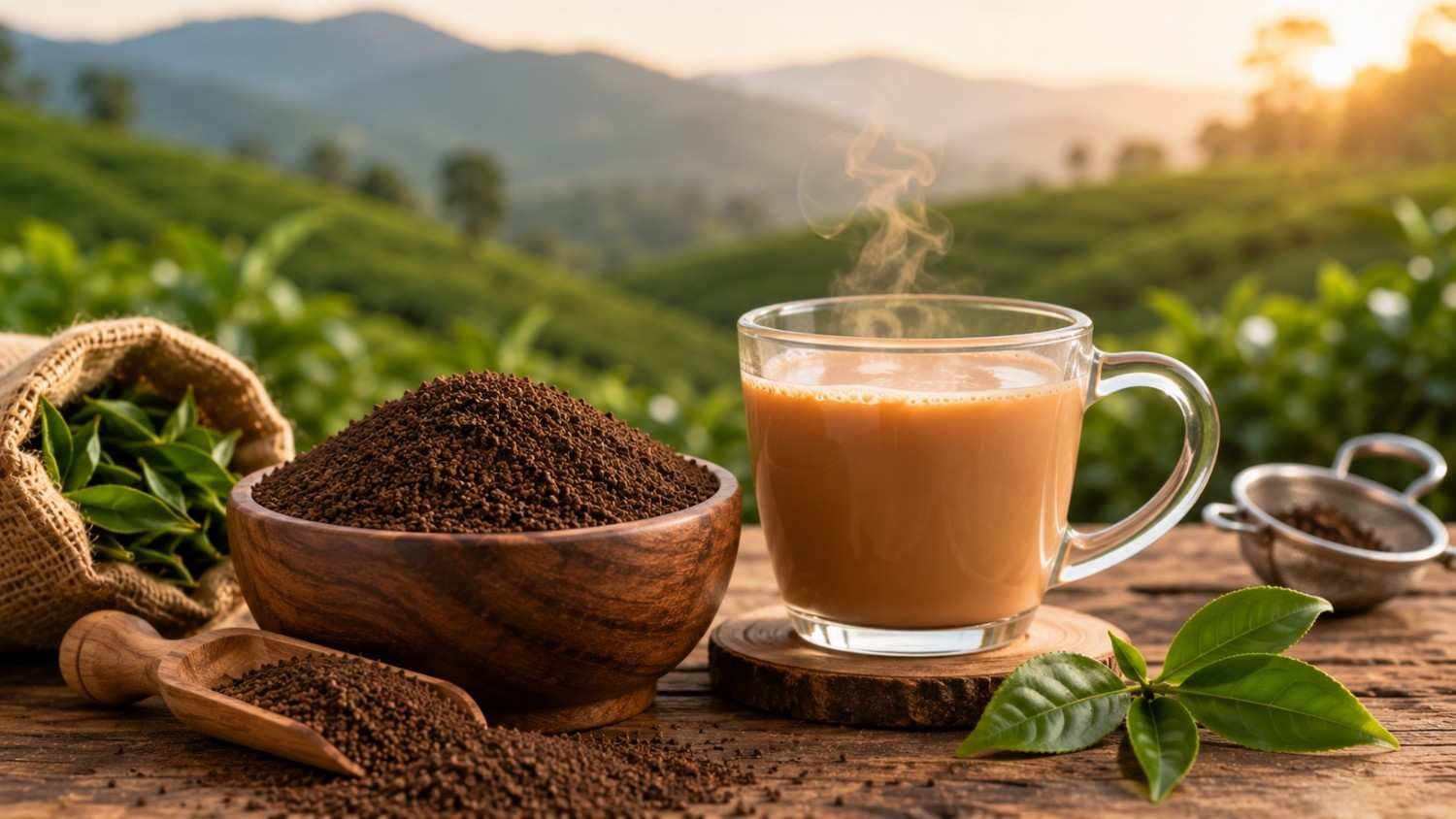
Every morning across India, hundreds of millions of pots come to a boil. A spoon goes in. Colour blooms within the minute. Milk follows. The result — bold, dark, fragrant — is the non-negotiable start to the day. Behind almost every one of those cups is a format most people have never consciously chosen: Dust tea powder. Not the same thing as leftover or low-grade tea, despite what the name might suggest. Not a second-best alternative to leaf tea. A deliberately engineered format, developed specifically for the Indian chai tradition, that at its finest produces a cup with no equivalent in any other brewing method. This post explains what dust tea powder actually is, why it dominates Indian kitchens, what separates premium from ordinary within the category, and how to get the best possible cup from it every single morning.
What Is Dust Tea Powder — and How Is It Made?
Dust tea powder is the finest particle grade produced by the CTC processing method. CTC — Crush, Tear, Curl — was developed in Assam in 1930 by William McKercher, a tea planter who recognised that the Indian market needed a tea format fundamentally different from the European leaf-steeping tradition. The Indian preference was always for a strong, milk-compatible brew that could be made quickly, at volume, and with complete consistency. CTC delivered all three.
In CTC processing, freshly harvested tea leaves — the top bud and first two leaves from Camellia sinensis — are withered briefly, then passed through cylindrical rollers fitted with small, sharp teeth that simultaneously crush, tear, and curl the leaf into tiny, uniform granules. These granules are then graded by particle size through a series of mesh screens. The finest fraction — the particles small enough to pass through the tightest mesh — is classified as dust.
This ultra-fine particle size is the source of dust tea powder’s defining characteristics. The vastly increased surface area exposed to water means extraction happens almost immediately upon contact with boiling water. Colour develops within 30 to 45 seconds. Flavour compounds are released completely, not gradually. The result is a brew that is faster, darker, and more uniform than any leaf-based format can produce.
The word “dust” carries connotations of residue or inferiority. In the context of tea processing, it carries neither. Dust grade is a deliberate specification — the format engineered for the speed, strength, and milk compatibility that Indian chai demands. When the source leaf is excellent, dust tea powder is excellent. The quality of the source is everything.
Why Altitude Makes All the Difference in Dust Tea Quality
The single most important variable in dust tea powder quality has nothing to do with particle size, processing method, or packaging. It is where the leaf grew before it entered the CTC machine.
Tea grown at high altitude — above 1,500 metres, as in Munnar’s Western Ghats estates — develops more slowly than tea grown on the plains. Lower temperatures reduce the plant’s metabolic rate, extending the time between leaf flush and harvest. That extended growing time is not idle: the plant accumulates higher concentrations of theaflavins, thearubigins, polyphenols, L-theanine, and the volatile aromatic oils that give a quality tin its signature aroma when opened.
These same compounds — responsible for the health benefits of black tea — are also responsible for its flavour. A cup with higher theaflavin content is more vibrant in colour, more complex in aroma, more satisfying in finish, and more persistent in warmth after the last sip. The cup that is better to taste is also the cup that is better for the body. These are the same quality, expressed in two different ways.
The practical implication is stark. Two tins of dust tea powder — one from a Munnar high-altitude estate, one from a low-altitude commodity blending facility — look identical on the shelf. At the same price point, they appear to offer the same product. Open both, breathe in, and the difference is immediate. Brew both side by side with the same method and quantity, and the difference is not subtle. Altitude-grown dust tea produces colour faster, aroma richer, and a finish that the commodity tin simply cannot sustain.
The Heritage of Dust Tea in Kerala’s Chai Culture
Dust tea did not enter Kerala’s domestic culture quietly. It arrived with the expansion of CTC production in the mid-20th century and was immediately absorbed into the existing tradition of strong, milk-based tea that the state had developed around the output of its own Munnar estates.
The chaya kada — Kerala’s iconic roadside tea stall — became the proving ground. A chaya kada serves dozens or hundreds of cups each day, always to customers with precise and unforgiving expectations. The cup must arrive deep amber. It must smell right before the first sip. It must hold its character through generous milk and sugar. It must leave a warmth that stays. Meeting these standards, at volume, without fail, requires a tea format designed for exactly this performance. Dust tea powder, from quality Munnar estates, is what the chaya kada runs on.
This is not sentimentality — it is functional reality. The chaya kada tradition shaped Kerala’s domestic tea standard: the household cup is measured against the standard of the best stall in the neighbourhood. That standard is high, and it is maintained by the quality of the dust in the tin.
What Makes Dust Tea Powder Good for Your Health
Dust tea powder, when sourced from high-altitude estates, delivers meaningful daily wellness benefits through every cup — not as an occasional supplement, but as a consistent part of the daily routine.
Theaflavins and thearubigins — the primary antioxidant compounds in black tea — are extracted rapidly and completely by dust tea’s fine particle size. A well-brewed dust tea cup delivers a full antioxidant dose in under two minutes, making it among the most efficient health-active beverages available to the everyday Indian drinker.
L-theanine, the amino acid that produces calm, focused alertness by moderating caffeine’s stimulant effects, is present in all quality black teas. The combination of L-theanine and caffeine in a well-brewed Munnar dust tea produces a sustained, clean alertness — the mental clarity without the spike and crash that caffeine alone causes.
Digestive support: Ayurveda classifies black tea as a deepana substance — a kindler of digestive fire. A morning cup of strong black tea activates digestive enzyme production and supports the body’s transition from the fasted state of sleep to the active state of the day. For this purpose, a robust dust tea brewed without excessive sweetener is the most effective daily practice.
When combined with warming spices in the tradition of a well-made Masala tea, the wellness profile expands further — ginger adds anti-inflammatory and digestive enzyme support, cardamom contributes respiratory and carminative benefits, and black pepper enhances the bioavailability of other bioactive compounds across the full cup.
How to Brew Dust Tea Powder for the Perfect Kerala Chai
Dust tea powder rewards a confident, unhurried method. The common mistakes — under-boiling the water, rushing the colour, adding milk too early — all produce a cup that is pale, flat, or thin relative to what quality dust tea is capable of.
The method:
Begin with cold water in the pot — never hot water from a tap or a previously boiled kettle. Cold water brought to a full, rolling boil produces a more oxygen-rich, texturally superior brew than water boiled twice. Use filtered or lightly mineralised water where possible; the mineral profile of the water directly affects extraction quality.
Add the dust tea powder to the boiling water — one heaped teaspoon per 150ml for a standard Kerala-strength cup; one and a half teaspoons for the deep, mahogany brew that the serious drinker expects. Reduce heat immediately to a medium simmer. Watch the colour: it should develop visibly within 30 to 45 seconds of addition. If it takes longer, the water was not at a full boil, or the tea has degraded.
After 60 to 90 seconds of simmering, add cold milk in a slow pour from a standing height. The standing pour aerates the brew and cools it slightly, preventing the scalded-milk flatness that occurs when boiling water and milk meet at the same temperature. Reduce heat to the lowest setting and allow the combined brew to simmer for a further 60 seconds.
Strain directly into the cup — never back into the pot. The cup should be a clear, deep copper-amber, consistent in colour and vibrant in the light. The aroma should rise from the cup immediately. Drink it hot.
Understanding Dust Tea Grades: How to Choose Within the Category
Not all dust tea powder is identical. Within the CTC dust classification, meaningful variation exists that affects both flavour and extraction performance.
Fine dust — the smallest particles — extracts fastest and produces the deepest colour at any given quantity. Ideal for the strong Kerala morning cup, large-batch brewing for households or commercial settings, and masala chai where the base tea must hold its character against powerful spices.
Slightly coarser dust (sometimes referred to as BPD — Broken Pekoe Dust, in trade terminology) brews marginally slower and produces fractionally more flavour complexity than the finest grade. The difference is subtle for most home brewers but noticeable in a direct comparison. Some experienced drinkers prefer this grade for solo cups where they want to actually taste the tea rather than primarily experience its strength.
Estate-sourced versus commodity blended: This distinction outweighs any grade distinction within the CTC dust category. Estate-sourced dust from a named Munnar garden will outperform commodity dust of any grade, because the source leaf is measurably better — more aromatic, more polyphenol-rich, fresher in processing. Look for origin transparency on the label. If the brand cannot tell you where its tea grew, it has good reason not to.
Comparing Dust Tea Powder with Other Tea Formats
Understanding where dust tea powder sits relative to other formats helps you use it most effectively and know when another format might serve you better.
Dust tea vs. leaf tea: Leaf tea brews more slowly and produces a more layered, nuanced flavour — better for those who want to taste the tea rather than primarily experience its strength. Dust tea brews fast and bold — better for the morning routine, large batches, and any preparation where milk and spice are central. Both are excellent; they serve different moments.
Dust tea vs. tea bags: Tea bags contain fannings — a step coarser than dust, packaged for convenience at the cost of both flavour and quality control. Tea bag format also makes origin transparency impossible. Quality CTC dust from a named estate outperforms any tea bag format in both cup quality and health return.
Dust tea vs. instant tea: Instant tea is spray-dried brewed tea — a processed convenience product with minimal active compound content. CTC dust tea is a minimally processed leaf-derived product. The comparison is unfavourable to instant tea in every dimension except speed of preparation.
For the vast majority of Indian households — those who brew chai two, three, or four times daily, who expect a dark and bold cup, and who do not have time for an elaborate brewing ritual on a weekday morning — quality estate-sourced dust tea powder is the optimal format. It is the format that Indian chai culture built itself around, and with good reason.
A Story From the Kitchen: When the Tin Changed Everything
Govindan, a retired school principal from Thrissur, spent forty years buying the same nationally distributed brand of tea powder. It was a fixed point in his household — predictable, familiar, never questioned.
His daughter, visiting from Kochi, brought a small pack of estate-sourced Munnar dust tea as a house gift. He used it the following morning with some scepticism, without changing his method or his timing.
“The colour came so fast,” he says. “I thought I had used too much.” He checked the amount — it was his usual spoon. “And then when I poured the milk, the colour held. My usual tea goes lighter after the milk. This one stayed.”
He finished the cup at the kitchen table instead of carrying it to his reading chair. “I wanted to look at it,” he says, with the slight embarrassment of someone describing a response they find disproportionate to its cause. “The colour was very good.”
He ordered two 500-gram packs the following week. Forty years of habit, changed by one tin. Not dramatically — the method, the timing, the tumbler are all the same. But the tin is different. And the cup knows.
Frequently Asked Questions
Q: What is dust tea powder and why is it used for chai? A: Dust tea powder is the finest CTC-processed tea grade — small, uniform particles that extract colour and flavour rapidly in boiling water. It was specifically developed for milk-based Indian chai because it brews fast, dark, and consistent, holding its character through generous milk and sugar better than any other tea format.
Q: Is dust tea powder lower quality than leaf tea? A: No — “dust” refers to particle size, not quality. Premium estate-sourced dust tea from high-altitude Munnar gardens can be exceptional. The quality of the source leaf determines cup quality. Dust grade simply brews faster and bolder; leaf grade brews more slowly with greater flavour complexity.
Q: How much dust tea powder should I use per cup? A: One heaped teaspoon (2–2.5 grams) per 150ml of water produces a standard Kerala-strength cup. For a deep, full-bodied brew, use one and a half teaspoons. Dust extracts efficiently — avoid exceeding two minutes total steeping time to prevent bitterness from over-extraction.
Q: What is the difference between dust tea and masala tea? A: Dust tea is the base black tea format; masala tea is dust or leaf black tea brewed with warming spices — typically ginger, cardamom, clove, and black pepper. A quality masala tea blend uses genuine spice alongside premium black tea, adding Ayurvedic digestive and anti-inflammatory benefits to every cup.
Q: How do I know if my dust tea powder is fresh and high quality? A: Open the tin and breathe in before brewing. Fresh, quality dust tea has a warm, earthy, woody aroma that presents itself immediately. Flat, faint, or musty smell means the tea has degraded. Also check for a packed-on date within three to four months, and a label that names a specific growing origin.
Q: Can dust tea powder be used for cold brew tea? A: Yes — though cold brewing works better with coarser grades. For dust tea, use half the usual quantity in cold, filtered water and steep 8–10 hours in the refrigerator. Strain through a fine mesh or coffee filter. The result is a smooth, low-bitterness concentrate that works well served over ice.
Conclusion: The Format That Built India’s Morning
Dust tea powder is not glamorous. It sits in a tin on the shelf, gets scooped into a pot before the house is properly awake, and does its job without ceremony or appreciation. But it is also the format responsible for more moments of genuine daily satisfaction than any other beverage format in the country — the cup that makes the morning real, the cup shared with the guest who arrived without warning, the cup that marks the end of the afternoon’s hardest hour.
When that dust comes from the right leaf — grown at altitude, freshly processed, honestly labelled — what it produces is not ordinary. It is the best version of the most familiar thing in the Indian kitchen. That is not a small achievement. For the households that choose it deliberately, it is the daily standard that everything else is measured against.
The method is simple. The difference is in the tin. Choose it with the care it deserves.