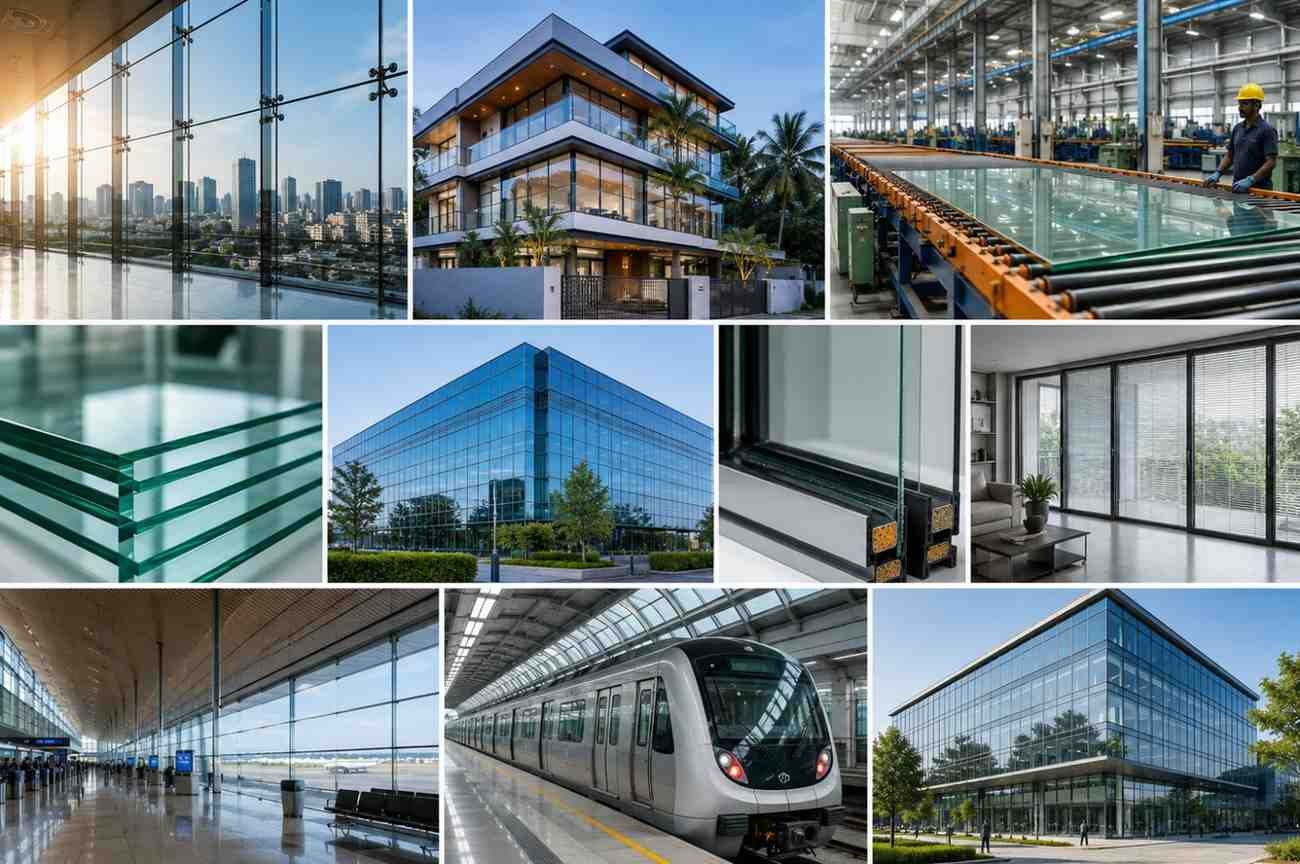
Kerala’s construction market is unlike any other in India. The state combines a design culture that embraces contemporary glass architecture with a climate that is among the most demanding for building materials — high humidity year-round, monsoon rainfall measured in metres, coastal salt air within kilometres of the shoreline, intense tropical UV irradiation, and periodic cyclonic wind events. For architects and developers building in Kerala, the selection of toughened glass manufacturers in kerala who genuinely understand these conditions — not just the general requirements of IS 2553 but the specific performance demands of Kerala’s coastal and tropical environment — is the starting point for glass installations that perform as designed for their full service life. Alongside structural performance, the protection of glass surfaces from UV degradation, biological growth, and mineral staining is addressed through uv protective glass with nano coating technology that maintains surface clarity and reduces maintenance frequency in Kerala’s challenging outdoor environment. This article covers every dimension of glass specification for Kerala’s unique construction context.
Understanding Kerala’s Construction Environment
Kerala sits entirely within the tropical wet climate zone, receiving an average of 3,000mm of annual rainfall in most coastal and midland areas, rising to over 5,000mm in the high-range districts. The state has two distinct monsoon periods — the southwest monsoon from June to September and the northeast monsoon from October to December — separated by relatively dry but still humid inter-monsoon periods. Temperatures are consistently warm year-round, typically between 25 and 35 degrees Celsius at the coast.
This climate profile creates specific challenges for building glass. Persistent high humidity — typically above 75 percent relative humidity throughout the year — accelerates the degradation of sealing materials, particularly silicone sealants that are not formulated for continuous wet exposure. The combination of humidity and biological nutrients in the air creates ideal conditions for algae, biofilm, and lichen growth on glass surfaces. Salt air within one to two kilometres of the shoreline deposits chloride compounds on metal fixings, hardware, and frame systems, driving corrosion rates that mainland Indian specifications do not account for.
Monsoon wind loading in exposed locations — particularly along the Malabar coast and in high-range areas subject to orographic wind amplification — can be substantial. IS 875 Part 3 classifies Kerala’s coastal and high-range areas in wind zones that require glass thickness calculations for building heights and panel sizes that would be under-specified using standard mainland assumptions.
UV irradiance in Kerala’s tropical location is significantly higher than in northern Indian cities. Year-round high-angle sun exposure — with UV Index regularly reaching 11 or above during summer months — accelerates UV-induced degradation of sealants, coatings, and interlayer materials that are not specified for high-UV environments.
Toughened Glass Performance in Kerala’s Coastal Conditions
The glass body itself — the toughened float glass panel — is chemically inert and unaffected by humidity, salt air, UV irradiation, or biological exposure. Standard toughened glass from a quality manufacturer will maintain its structural performance indefinitely under Kerala’s atmospheric conditions, provided it is not mechanically damaged and its edge quality is maintained.
What does deteriorate in coastal Kerala installations is everything around the glass — the hardware, fixings, frame systems, and sealants that hold the glass panel in its structural position. A toughened glass panel correctly specified for its structural loading will outlast its hardware system in a coastal environment if the hardware is not also specified for coastal conditions.
The practical specification implication is straightforward but frequently overlooked: all hardware in glass installations within one kilometre of the Kerala coastline must be specified in marine-grade stainless steel (Grade 316 at minimum), all silicone sealants must be marine-grade UV-stabilised formulations, and all frame systems must be finished with marine-grade powder coating or anodising that resists chloride attack.
For glass installations in Kerala’s most exposed coastal locations — beachfront hotels in Kovalam and Varkala, waterfront commercial developments in Kochi, and coastal resort villas throughout the state — the hardware and sealant specification is as critical as the glass specification itself, and should be confirmed with the glass supplier’s technical team alongside the glass product specification.
UV Protective Glass for Kerala’s High-Irradiance Environment
Kerala’s tropical UV environment affects both the glass surface itself and the materials used with it. Standard clear glass transmits approximately 70 percent of UV radiation — meaning that interior furnishings, flooring, and artwork in glass-fronted Kerala buildings are exposed to UV levels that cause accelerated fading, discolouration, and material degradation.
UV protective glass with nano coating or low-iron glass combined with UV-filtering interlayers in laminated construction blocks over 99 percent of UV radiation while maintaining excellent visible light transmission. For Kerala’s luxury residential and hospitality market — where interior furnishings represent significant investment and where the appearance quality of interiors directly affects property value and guest experience — UV-protective glass is a specification that protects a real financial interest.
Nano coated UV protective glass also provides surface performance benefits that are particularly relevant in Kerala’s climate. The photocatalytic TiO2 coating breaks down organic deposits on the glass surface under UV irradiation — using Kerala’s abundant UV as energy to maintain the glass surface cleanliness between cleaning cycles. The high-rainfall environment provides the water activation that the self-cleaning mechanism requires. Together, these mechanisms dramatically reduce the rate of biological growth and mineral staining that afflicts uncoated glass facades in tropical Kerala environments.
For Kerala’s commercial buildings — office towers in Kochi’s commercial districts, IT campuses in Technopark and Infopark, healthcare facilities in Thiruvananthapuram and Kozhikode — UV protective coated glass on external facades reduces the cleaning and maintenance cost that tropical surface soiling imposes, while protecting the quality of interior environments that support productive occupancy.
Monsoon Wind Loading and Glass Thickness in Kerala
Glass thickness specification in Kerala must account for the state’s wind loading requirements explicitly — not rely on mainland India thickness tables that do not reflect coastal Kerala’s exposure. IS 875 Part 3 classification for Kerala’s coastal districts assigns basic wind speeds of 44 to 50 m/s depending on location, generating dynamic wind pressures that require thickness calculations for each specific panel dimension and support condition.
For high-rise buildings along Kerala’s coast — increasingly common in Kochi and emerging in coastal towns throughout the state — the combination of coastal wind zone classification and height amplification creates design wind pressures at upper floors that require glass specifications significantly heavier than standard commercial practice. A 12mm toughened glass panel adequate for a mid-height panel in Bengaluru may need to be 15mm or 19mm for the same panel dimensions at the same height in a coastal Kerala location.
Structural engineers working on Kerala projects should calculate panel-specific design wind pressures using IS 875 Part 3 for the specific site coordinates, building height, and terrain category, and confirm glass thickness from those calculations rather than from standard thickness tables. Toughened glass manufacturers with Kerala project experience will be familiar with the wind loading requirements of different parts of the state and can support the structural engineer with glass strength data for the specific products being considered.
Building Types Driving Kerala’s Glass Market
Hospitality is the largest single driver of premium glass specification in Kerala. The state’s thriving tourism sector — generating demand for luxury hotels, boutique resorts, ayurvedic retreat facilities, and backwater houseboats and floating villas — creates a continuous market for high-quality architectural glass that combines visual performance with tropical durability.
IT and commercial development in Kochi’s Smart City zone, Thiruvananthapuram’s Technopark, and the emerging commercial districts of Kozhikode and Thrissur is driving demand for glass curtain walls and partition systems in contemporary commercial buildings designed to international occupancy standards.
Healthcare infrastructure is growing rapidly across Kerala with new hospital campuses, specialist diagnostic centres, and medical college facilities that require glass specification for patient safety, infection control, and clinical environment quality simultaneously.
Luxury residential development — coastal villas, hill station retreats in Munnar and Wayanad, and premium apartment developments in Kochi and Thiruvananthapuram — creates demand for UV protective glass, large-format toughened glass balustrades and sliding door systems, and marine-grade glass hardware appropriate for coastal humidity conditions.
Frequently Asked Questions
What stainless steel grade is required for glass hardware in coastal Kerala?
Grade 316 austenitic stainless steel is the minimum specification for all glass hardware — hinges, patch fittings, point fixings, and handles — within one kilometre of Kerala’s coastline. For highly exposed beachfront locations with direct salt spray exposure, duplex stainless steel Grade 2205 provides additional chloride corrosion resistance and is the preferred specification.
How does Kerala’s humidity affect double glazed unit performance?
The sealed cavity of a double glazed unit is unaffected by exterior humidity — the seal prevents moisture entry. The edge seal system is the vulnerable element. In Kerala’s high-humidity environment, dual-seal double glazed units with polysulphide or silicone secondary sealant and warm-edge spacer bars provide the best long-term seal integrity. Single-seal units are not recommended for Kerala’s continuous humidity exposure.
Is UV protective glass necessary for interior glass in Kerala buildings?
For interior glass that does not face direct exterior exposure — internal partitions, shower screens, internal balustrades — standard toughened glass is appropriate. UV protective glass is most valuable on exterior-facing surfaces where UV filtration protects both interior contents and the glass surface itself from the photodegradation and biological growth that Kerala’s tropical UV environment drives.
Can toughened glass be specified for Kerala’s cyclone-exposed locations?
For buildings in cyclone-exposed locations on Kerala’s western coast, laminated glass is the appropriate specification for facade panels that may be subject to wind-driven debris impact. Standard toughened glass does not pass large missile impact testing — it breaks under impact and allows penetration. Laminated glass with PVB or SGP interlayer maintains envelope integrity after impact, providing weather exclusion until replacement panels are available.
What is the cleaning interval for nano coated glass in Kerala’s climate?
In Kerala’s high-rainfall, high-UV tropical climate, photocatalytic nano coated glass typically achieves cleaning intervals of 12 to 18 months compared to 3 to 6 months for uncoated glass in similar exposure conditions. The combination of frequent rainfall activating the hydrophilic flushing mechanism and intense UV activating the photocatalytic cleaning mechanism creates ideal conditions for self-cleaning glass performance.
Conclusion
Kerala’s construction market demands glass specification that goes beyond the standard Indian mainland approach — accounting for coastal salt exposure, monsoon wind loads, tropical UV intensity, persistent humidity, and the biological surface growth that thrives in warm, wet conditions. Toughened glass manufacturers who understand these specific demands — and who can support projects with climate-appropriate product specifications, marine-grade hardware guidance, and UV protective surface treatment options — are the partners that Kerala construction projects need.
Buildings that get this right deliver facades and glazing systems that remain beautiful, safe, and low-maintenance for their full design life in one of India’s most demanding and rewarding construction environments.
Toughened glass manufacturers kerala, UV protective glass tropical, Kerala glass specification, coastal glass india, monsoon glass specification, toughened glass coastal, self cleaning glass kerala, marine grade glass hardware, glass manufacturer kerala, IS 875 Kerala wind load